TurboQuant, recently unveiled by Google, is a pioneering algorithmic suite and library designed to apply advanced quantization and compression techniques to large language models (LLMs) and vector search engines—a critical component of retrieval-augmented generation (RAG) systems. This Q&A explores how TurboQuant revolutionizes key-value (KV) cache compression, delivering significant memory savings while maintaining model accuracy. Below, we address the most common questions about this technology.
What Exactly Is TurboQuant and What Problem Does It Solve?
TurboQuant is a specialized library and algorithmic framework developed by Google to tackle the memory and latency bottlenecks that arise when deploying large language models and vector search engines at scale. In LLMs, the key-value (KV) cache—which stores intermediate attention states—grows linearly with sequence length and batch size, quickly consuming vast amounts of GPU memory. For vector search engines used in RAG pipelines, storing and comparing high-dimensional embeddings similarly strains resources. TurboQuant addresses these challenges by applying cutting-edge quantization and compression methods that reduce the footprint of KV caches and vector stores, often by 2–4×, with minimal accuracy loss. This enables longer context windows, larger batch sizes, and faster inference, directly supporting the demands of production RAG systems.
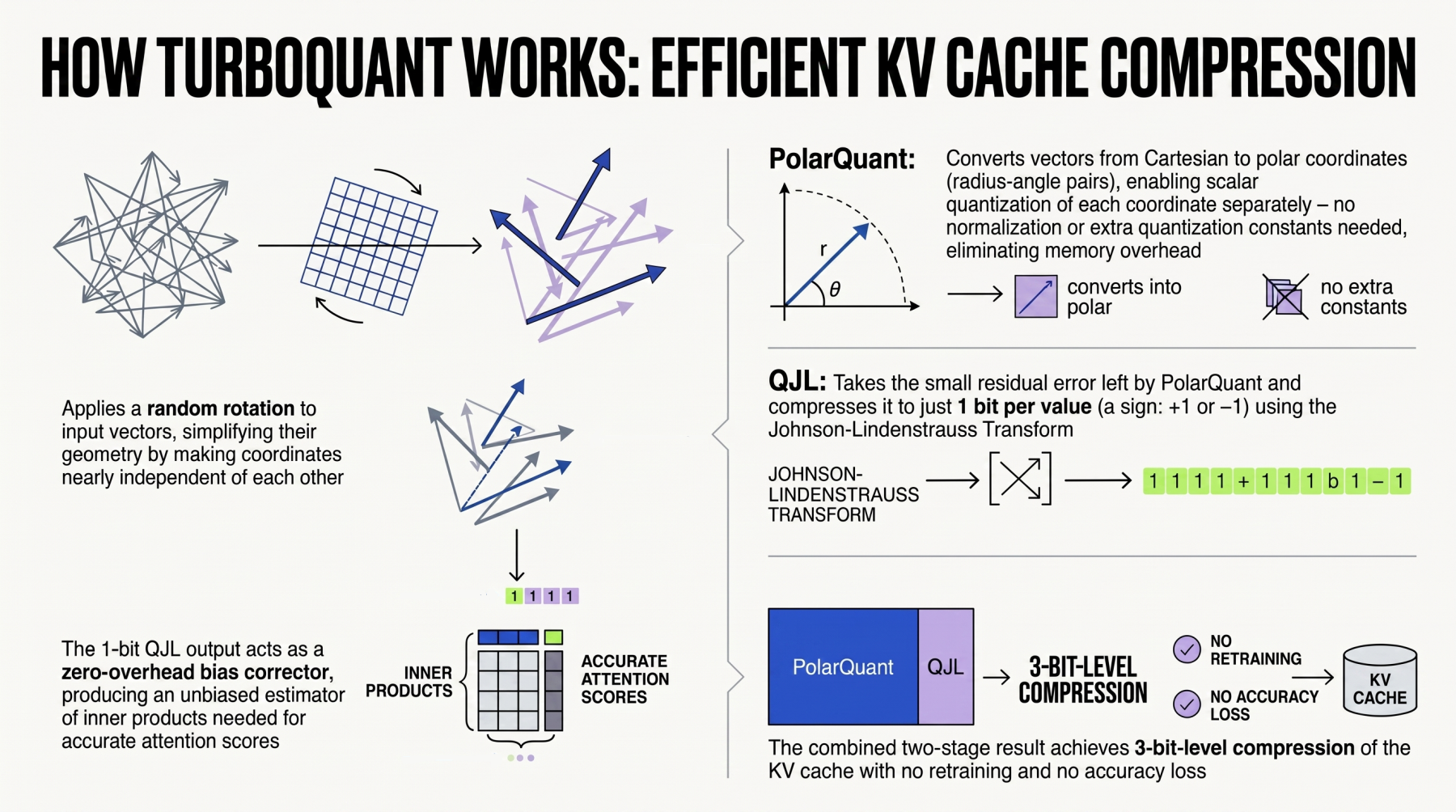
How Does TurboQuant Achieve Efficient KV Cache Compression?
TurboQuant uses a combination of techniques to shrink the KV cache without sacrificing model quality. First, it employs per‑token quantization, where each key and value tensor is converted from 16‑bit floating point to 8‑bit (or even 4‑bit) integer representations using learned scaling factors. Second, it introduces group‑wise quantization that dynamically adjusts precision based on statistical properties of the cache entries—important tokens get higher precision while less influential ones are compressed more aggressively. Third, TurboQuant applies adaptive pruning to remove redundant or near‑zero entries from the cache. These steps are orchestrated through a custom CUDA kernel library that minimizes runtime overhead. The result is a compressed state that occupies a fraction of the original memory, allowing models to handle up to 4× longer sequences within the same hardware budget.
What Are the Primary Benefits of TurboQuant for RAG Systems?
Retrieval‑augmented generation (RAG) systems rely on two core components: a vector search engine for document retrieval and an LLM for generating answers. TurboQuant directly benefits both. For the vector search engine, it compresses stored embeddings, reducing index memory usage by up to 75% while maintaining high recall. For the LLM, it compresses the KV cache, enabling the model to ingest longer retrieved contexts (e.g., whole documents) without running out of GPU memory. This means that RAG pipelines can process more documents in a single inference pass, improving answer completeness and reducing latency. Additionally, the compression reduces data movement between memory and compute units, leading to faster token generation. TurboQuant thus helps RAG systems scale to larger knowledge bases and longer contexts without requiring expensive hardware upgrades.
Is TurboQuant Compatible with Existing LLM Frameworks and Hardware?
Yes, TurboQuant is designed for broad compatibility. It integrates with popular deployment frameworks such as TensorFlow Lite, PyTorch, and JAX via lightweight API wrappers. The library provides pre‑tuned quantization plans for common architectures like GPT‑style decoders, BERT, and T5. On the hardware side, TurboQuant leverages standard CUDA operations and has been optimized for NVIDIA GPUs fromVolta onwards, though inference on other accelerators is possible with minimal modifications. The library automatically detects the target device and selects the appropriate compression strategy—for example, using 8‑bit on older GPUs and 4‑bit on Ampere or newer. This flexibility allows teams to adopt TurboQuant without redesigning their existing infrastructure, making it a pragmatic choice for production environments.
How Does TurboQuant Compare to Other KV Compression Methods?
Existing KV compression approaches can be broadly categorized into quantization‑only methods (e.g., smooth quantization), sparse attention mechanisms (e.g., sliding windows), and pruning‑based techniques. TurboQuant distinguishes itself by combining multiple compression axes—quantization, pruning, and adaptive precision—in a single, automatically tuned pipeline. While other methods might achieve 2× reduction, TurboQuant often delivers 3–4× with negligible quality degradation, as demonstrated in Google’s benchmarks. Moreover, TurboQuant’s library is open‑source and includes a hyperparameter search component that automatically finds the best compression configuration for a given model and latency budget, removing tedious manual tuning. For RAG systems where both retrieval and generation must be optimized simultaneously, TurboQuant’s unified approach provides a clear advantage.
What Are the Key Use Cases for TurboQuant Beyond RAG?
While RAG is a prominent application, TurboQuant’s benefits extend to any scenario involving large transformer models. For real‑time chatbots, the reduced KV cache allows maintaining multi‑turn conversation history (hundreds of previous tokens) without memory overflow. In code generation tools, it enables processing entire files or repositories as context. For long‑form text summarization, models can handle documents of up to 32K tokens on a single consumer GPU. Additionally, TurboQuant can compress the cross‑attention cache in encoder‑decoder models used for machine translation or speech recognition. Even vector search indexes used in recommendation systems and image retrieval benefit from the compression algorithms. By freeing memory, TurboQuant also reduces inference costs in cloud deployments, making advanced AI capabilities more accessible.
How Can Developers Get Started with TurboQuant Today?
Developers can access TurboQuant through its official GitHub repository, which includes installation instructions, pre‑trained quantization profiles, and examples for popular model families. The library supports Python 3.10+ and requires CUDA 11.8 or later. A typical workflow involves loading a model (e.g., via Hugging Face Transformers), applying the TurboQuant.quantize() function to the KV cache layers, and then running inference as usual. The repository also provides a command‑line tool for benchmarking different compression settings. For RAG systems, TurboQuant can be integrated with vector databases like FAISS or ScaNN by compressing embedding tables. Google has released detailed tutorials and a research paper explaining the underlying algorithms. The community is encouraged to contribute new compression strategies through a plugin interface, making TurboQuant a collaborative platform for advancing efficient AI inference.