Introduction
Every December, millions of Spotify users eagerly share their personalized Wrapped highlights. But behind the colorful graphics and catchy summaries lies an intricate engineering process. This step-by-step guide reveals how Spotify’s data scientists, engineers, and designers collaborate to transform raw listening data into your unique year-end story. Whether you're a tech enthusiast or a curious listener, you'll discover the method behind the magic.
What You Need
- Global user listening data – billions of streams across millions of tracks, artists, and podcasts.
- Scalable data infrastructure – cloud storage, stream processing frameworks (e.g., Apache Beam, Google Cloud Dataflow).
- Machine learning models – for pattern recognition, anomaly detection, and personalization.
- Storytelling algorithms – that select and sequence highlights into a narrative.
- Design assets – interactive templates, animations, and branding.
- Testing environments – for A/B validation and performance checks.
Step 1: Collect and Organize Global Listening Data
The foundation of Wrapped is raw data. Throughout the year, Spotify’s backend logs every play, skip, like, and share. For Wrapped, engineers filter the data for the calendar year (January 1 to October 31, 2025, to allow time for processing). The data is aggregated by user, artist, track, genre, and listening context (e.g., playlists, radio, discovery mode).
Using batch processing pipelines, the team cleans duplicates, normalizes timestamps, and ensures privacy by anonymizing identifiers before storage. This step is critical: it takes weeks to process trillions of events across distributed clusters.
Step 2: Identify Key Listening Moments
With clean data, engineers apply statistical models to detect listening highlights. Examples include:
- Top artists and tracks by total stream count
- Peak listening periods (e.g., most active hour or day)
- Genre shifts (when you suddenly explored a new style)
- Repeated plays of a single song (your “obsession” moment)
They also calculate listening distance (how your taste evolved) and audio aura (moods based on track audio features like energy and valence). These metrics are saved per user into a structured dataset.
Step 3: Apply Personalization Algorithms
Personalization transforms generic stats into a story that feels uniquely yours. Engineers use collaborative filtering and deep learning to compare your listening patterns with millions of others. For instance, if you listened to a rare indie band that only 1% of users discovered, that becomes a highlighted “early adopter” moment.
Contextual factors also matter:
- What you played during commutes, workouts, or late nights
- Podcast episodes you finished (vs. abandoned)
- Artists you followed or unfollowed
The algorithm ranks potential highlights by surprise, relevance, and shareability, then selects a subset that best represents your year.
Step 4: Craft the Narrative Arc
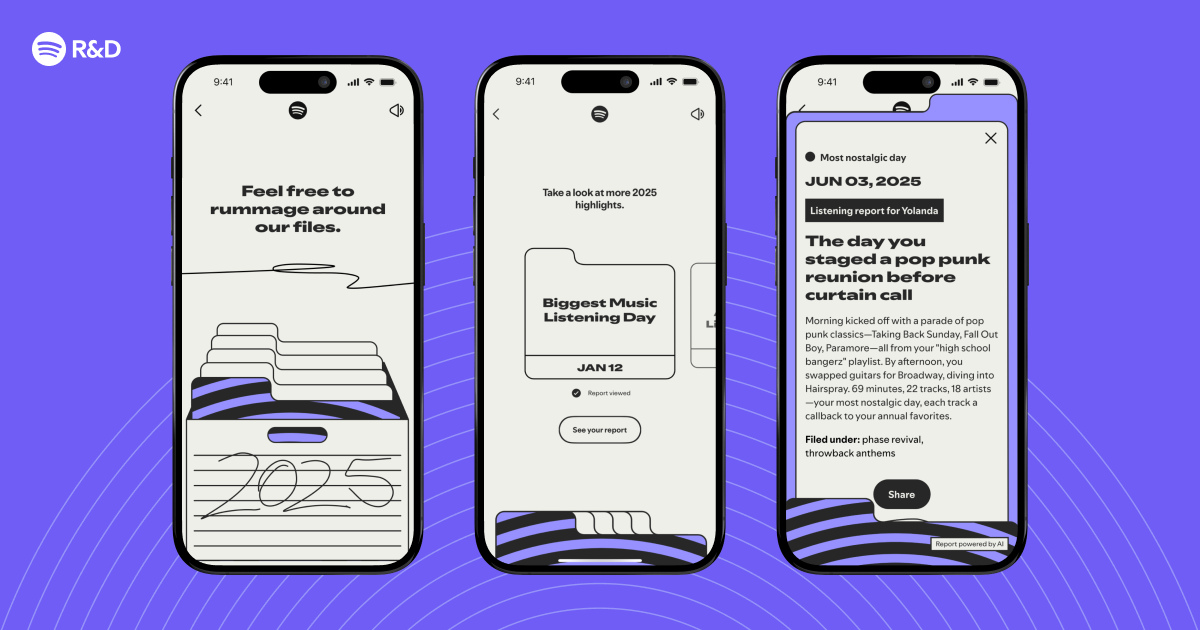
Once candidate highlights are chosen, a storytelling engine sequences them into a logical flow. The narrative typically starts with a broad summary (minutes listened), moves to top artists and songs, then reveals niche moments, and ends with a “listening personality” or audio aura.
Engineers use reinforcement learning to test multiple sequences and measure user engagement (e.g., how long they linger on each slide). The most engaging order is locked in for final production.

For 2025 Wrapped, the team added interactive elements like a custom “time capsule” of your earliest play of the year and a “genre journey” map showing how your taste migrated.
Step 5: Design the Visual and Interactive Experience
Parallel to data processing, the design team creates templates that adapt to each user’s unique data. Engineers integrate these designs using React and WebGL to render smooth animations on mobile and web.
Key technical considerations:
- Responsive layouts – the same story looks great on a phone, tablet, or desktop.
- Dynamic text sizing – artist names with many characters don’t break the design.
- Color schemes – generated from your top album covers using image color extraction.
Accessibility features (screen reader support, high contrast modes) are also added during this stage.
Step 6: Test and Launch
Before Wrapped goes live to hundreds of millions of users, it undergoes rigorous A/B testing. A small percentage of users see a beta version to verify that the highlights load correctly, the personalization feels accurate, and the narrative is engaging. Engineers monitor error rates, load times, and click-through rates.
Last-minute fixes are applied, and then a global rollout begins region by region. The team also prepares a scaling plan to handle the viral spike when users share their Wrapped on social media.
Tips for Getting the Most Out of Your 2026 Wrapped
- Listen broadly early in the year – the algorithm favors diversity; exploring new genres early increases the chance of a “genre journey” highlight.
- Use playlists like Discover Weekly and Release Radar – these influence which new artists get surfaced in your Wrapped.
- Don’t skip songs you love – repeated listening increases the likelihood of an “obsession” moment.
- Follow your favorite artists – follows are tracked and can appear as “new artist you discovered” highlights.
- Engage with podcasts too – for 2025, podcast highlights were featured prominently; finish episodes to get credit.
For engineers: consider adding emotional arcs (mood changes over months) or collaborative highlights (when you listened to the same song as a friend at the same time) to deepen the story.
By following these steps, Spotify turns raw data into a personalized year-in-review that resonates with millions. Next December, you’ll know exactly how the magic works.